
Anti-Inflammatory Constituents of Antrodia camphorata on RAW 264.7 Cells Induced by Polyinosinic-Polycytidylic Acid
Abstract
Antrodia camphorata is an endemic mushroom in Taiwan. This study was designed to screen anti-inflammatory compounds from the methanolic extract of the mycelium of A. camphorata on nitric oxide (NO) production in RAW 264.7 cells induced by polyinosinic-polycytidylic acid (poly I:C), a synthetic analog of double-stranded RNA (dsRNA) known to be present in viral infection. A combination of bioactivity-guided isolation with an NMR-based identification led to the isolation of 4-acetylantroquinonol B (1), along with seven compounds. The structure of new compounds (4 and 5) was elucidated by spectroscopic experiments, including MS, IR, and NMR analysis. The anti-inflammatory activity of all isolated compounds was assessed at non-cytotoxic concentrations. 4-Acetylantroquinonol B (1) was the most potent compound against poly I:C-induced NO production in RAW 264.7 cells with an IC50 value of 0.57 ± 0.06 μM.
Figures 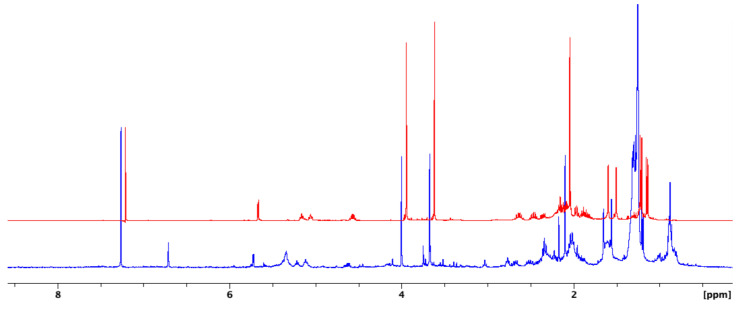
Figure 1
Stacked 1 H NMR spectra…
Figure 1
Stacked 1 H NMR spectra of the bioactive Fraction 5 (blue) and the…
Figure 1 Stacked 1H NMR spectra of the bioactive Fraction 5 (blue) and the major compound 4-acetylantroquinonol B (red).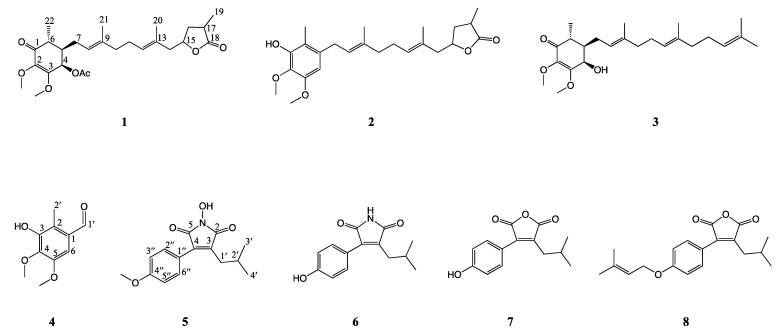
Figure 2
The structures of compounds 1…
Figure 2
The structures of compounds 1 – 8 from the mycelium of A. camphorata…
Figure 2 The structures of compounds 1–8 from the mycelium of A. camphorata.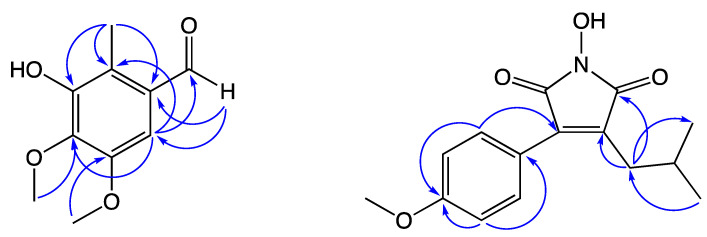
Figure 3
Key HMBC correlations of compounds…
Figure 3
Key HMBC correlations of compounds 4 and 5 .
Figure 3 Key HMBC correlations of compounds 4 and 5.