
Anti-Cancer Potential of Edible/Medicinal Mushrooms in Breast Cancer
Abstract
Edible/medicinal mushrooms have been traditionally used in Asian countries either in the cuisine or as dietary supplements and nutraceuticals. In recent decades, they have aroused increasing attention in Europe as well, due to their health and nutritional benefits. In particular, among the different pharmacological activities reported (antibacterial, anti-inflammatory, antioxidative, antiviral, immunomodulating, antidiabetic, etc.), edible/medicinal mushrooms have been shown to exert in vitro and in vivo anticancer effects on several kinds of tumors, including breast cancer. In this article, we reviewed mushrooms showing antineoplastic activity again breast cancer cells, especially focusing on the possible bioactive compounds involved and their mechanisms of action. In particular, the following mushrooms have been considered: Agaricus bisporus, Antrodia cinnamomea, Cordyceps sinensis, Cordyceps militaris, Coriolus versicolor, Ganoderma lucidum, Grifola frondosa, Lentinula edodes, and Pleurotus ostreatus. We also report insights into the relationship between dietary consumption of edible mushrooms and breast cancer risk, and the results of clinical studies and meta-analyses focusing on the effects of fungal extracts on breast cancer patients.
Figures 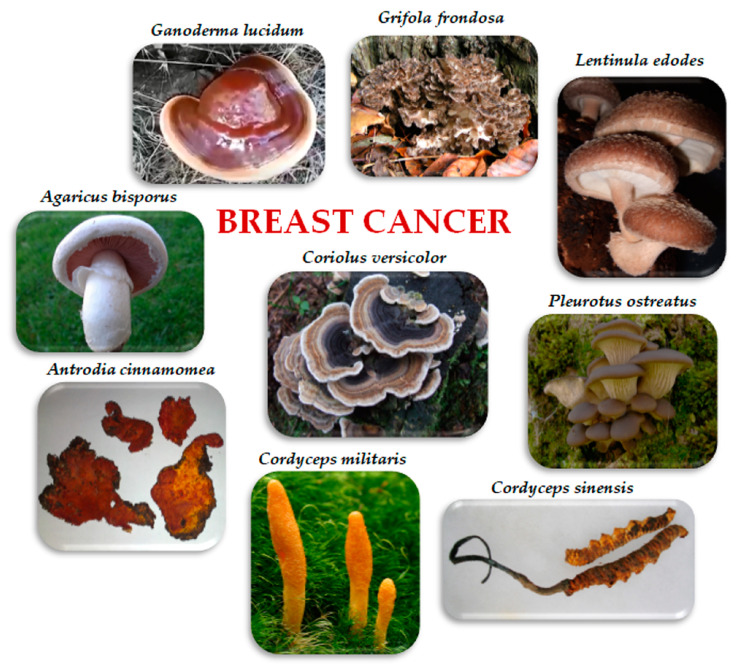
Figure 1
Edible/medicinal mushrooms active in breast…
Figure 1
Edible/medicinal mushrooms active in breast cancer considered in this review (credits: Agaricus bisporus…
Figure 1 Edible/medicinal mushrooms active in breast cancer considered in this review (credits: Agaricus bisporus, by Jerzy Opioła, Own work, CC BY-SA 3.0, https://commons.wikimedia.org/w/index.php?curid=24843662; Antrodia cinnamomea, by Thomaswz19, Own work, CC BY-SA 3.0, https://commons.wikimedia.org/w/index.php?curid=30570855; Cordyceps militaris, By Andreas Kunze, Own work, CC BY-SA 3.0, https://commons.wikimedia.org/w/index.php?curid=16244069; Cordyceps sinensis, by L. Shyamal, Own work, CC BY-SA 3.0, https://commons.wikimedia.org/w/index.php?curid=4116391; Coriolus versicolor, by Jerzy Opioła, Own work, CC BY-SA 3.0, https://commons.wikimedia.org/w/index.php?curid=25175312; Ganoderma lucidum, by Shane Hanofee, Attribution, https://en.wikipedia.org/w/index.php?curid=64332594; Grifola frondosa, by Pethan, CC BY-SA 3.0, https://commons.wikimedia.org/w/index.php?curid=1792907; Lentinula edodes, by frankenstoen from Portland, Oregon, Shiitake Mushrooms, CC BY 2.0, https://commons.wikimedia.org/w/index.php?curid=7304024; Pleurotus ostreatus, by Archenzo, Own work, CC BY-SA 3.0, https://commons.wikimedia.org/w/index.php?curid=3005251, accessed on 29 April 2023).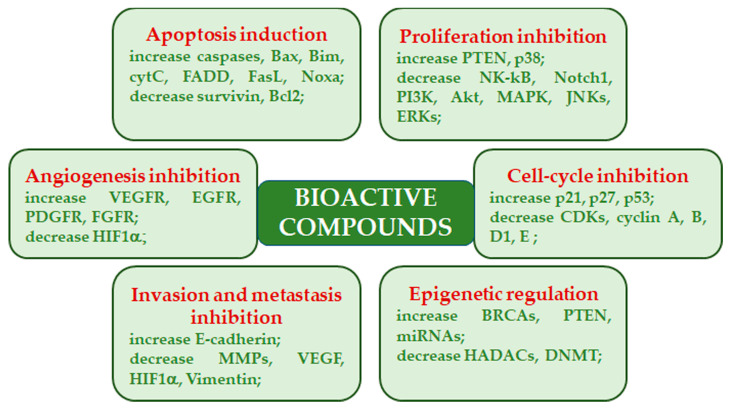
Figure 2
Some of the mechanisms related…
Figure 2
Some of the mechanisms related to the in vitro antineoplastic activity of bioactive…
Figure 2 Some of the mechanisms related to the in vitro antineoplastic activity of bioactive mushroom compounds in BC.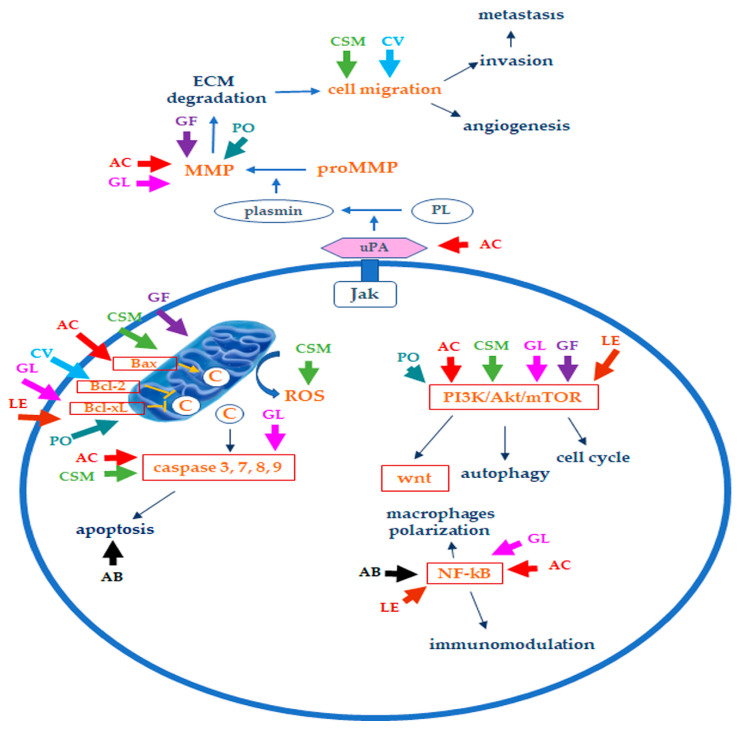
Figure 3
Simplified scheme of the mechanisms…
Figure 3
Simplified scheme of the mechanisms involved in the effects of the considered mushrooms…
Figure 3 Simplified scheme of the mechanisms involved in the effects of the considered mushrooms on breast cancer (Agaricus bisporus, AB; Antrodia cinnamomea, AC; Cordyceps sinensis and Cordyceps militaris, CSM; Coriolus versicolor, CV; Ganoderma lucidum, GL; Grifola frondosa, GF; Lentinula edodes, LE; Pleurotus ostreatus, PO).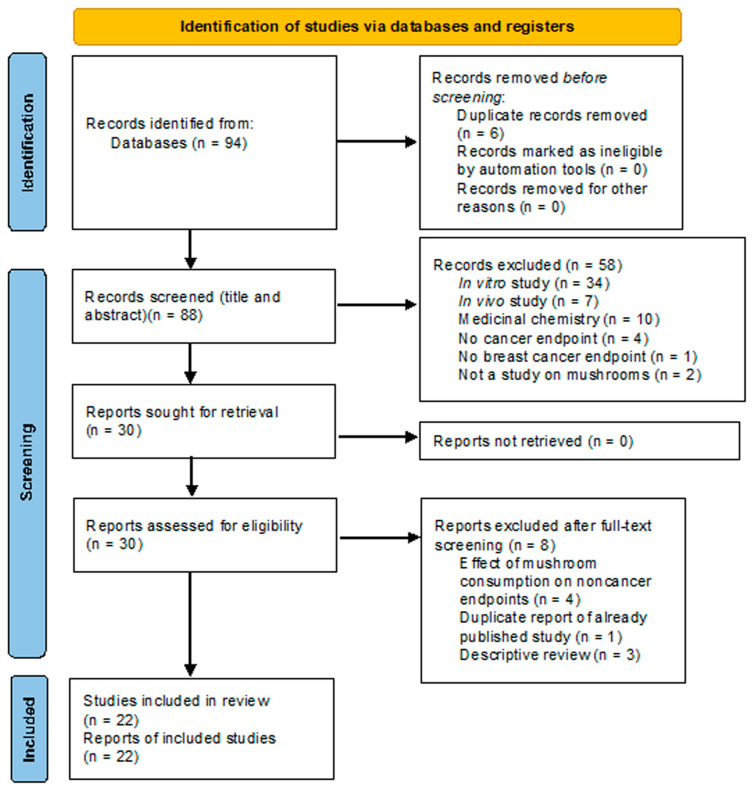
Figure 4
PRISMA flow chart of the…
Figure 4
PRISMA flow chart of the process of record retrieval and screening, with reasons…
Figure 4 PRISMA flow chart of the process of record retrieval and screening, with reasons for exclusion.