
Antrodia cinnamomea Suppress Dengue Virus Infection through Enhancing the Secretion of Interferon-Alpha
Abstract
Dengue caused by dengue virus (DENV) is a mosquito-borne disease. Dengue exhibits a wide range of symptoms, ranging from asymptomatic to flu-like illness, and a few symptomatic cases may develop into severe dengue, leading to death. However, there are no effective and safe therapeutics for DENV infections. We have previously reported that cytokine expression, especially inflammatory cytokines, was altered in patients with different severities of dengue. Antrodia cinnamomea (A. cinnamomea) is a precious and endemic medical mushroom in Taiwan. It contains unique chemical components and exhibits biological activities, including suppressing effects on inflammation and viral infection-related diseases. According to previous studies, megakaryocytes can support DENV infection, and the number of megakaryocytes is positively correlated with the viral load in the serum of acute dengue patients. In the study, we investigated the anti-DENV effects of two ethanolic extracts (ACEs 1-2) and three isolated compounds (ACEs 3-5) from A. cinnamomea on DENV infection in Meg-01 cells. Our results not only demonstrated that ACE-3 and ACE-4 significantly suppressed DENV infection, but also reduced interleukin (IL)-6 and IL-8 levels. Moreover, the level of the antiviral cytokine interferon (IFN)-α was also increased by ACE-3 and ACE-4 in Meg-01 cells after DENV infection. Here, we provide new insights into the potential use of A. cinnamomea extracts as therapeutic agents against DENV infection. However, the detailed mechanisms underlying these processes require further investigation.
Figures 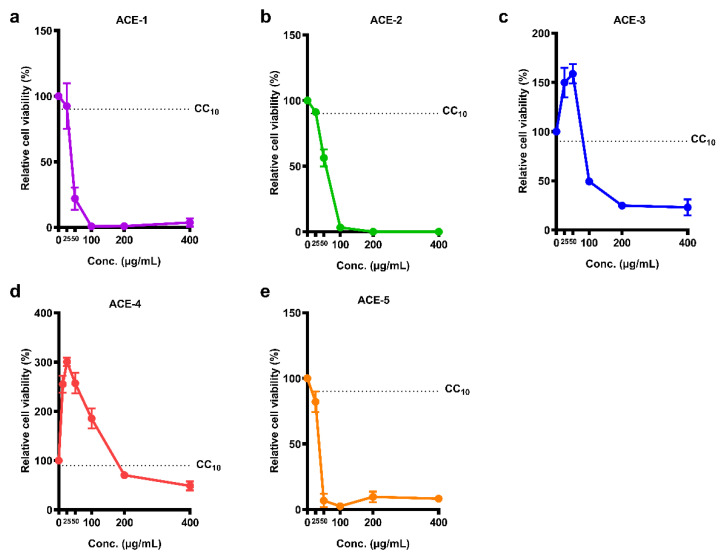
Figure 1
Cell viability of the five…
Figure 1
Cell viability of the five A. cinnamomea extracts in Meg-01 cells. Meg-01 cells…
Figure 1 Cell viability of the five A. cinnamomea extracts in Meg-01 cells. Meg-01 cells were cultured with different concentrations of A. cinnamomea extracts, (a) ACE-1, (b) ACE-2, (c) ACE-3, (d) ACE-4, and (e) ACE-5, for 24 h followed by reacting with WST-1 reagent. All the values represent as mean ± SEM of three experiments. The dotted line represents the value of CC10.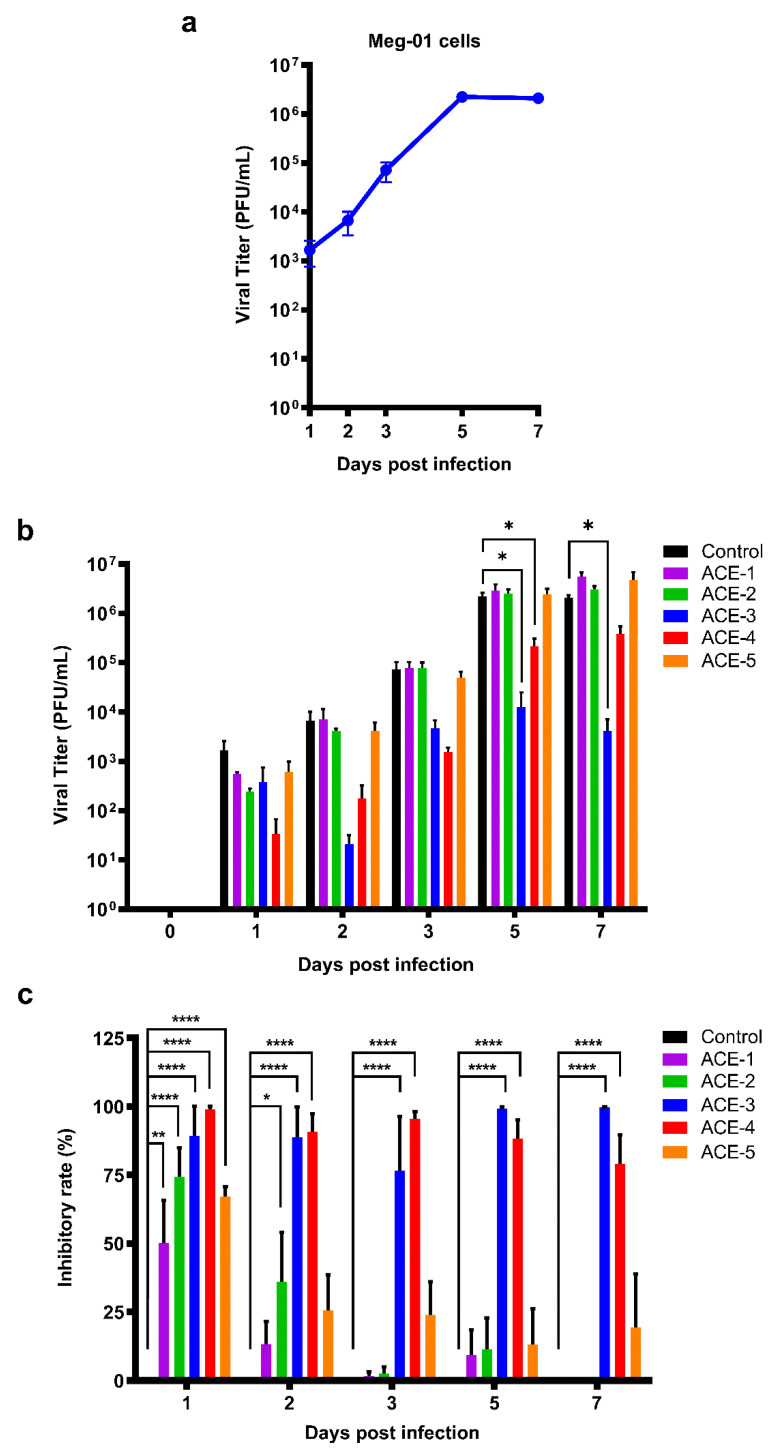
Figure 2
Both ACE-3 and ACE-4 could…
Figure 2
Both ACE-3 and ACE-4 could significantly inhibit DENV replication. ( a ) Replication…
Figure 2 Both ACE-3 and ACE-4 could significantly inhibit DENV replication. (a) Replication curve of DENV in Meg-01 cells, and the peak of the titer was showed at day 5 post infection. (b) The viral titers of DENV in the A. cinnamomea extracts-treated Meg-01 cells. (c) The inhibitory rate of the A. cinnamomea extracts against DENV infection in Meg-01 cells. All the values represent as mean ± SEM of three experiments. p values were calculated using two-way ANOVA, statistically significant difference * p < 0.05, ** p < 0.01, **** p < 0.0001.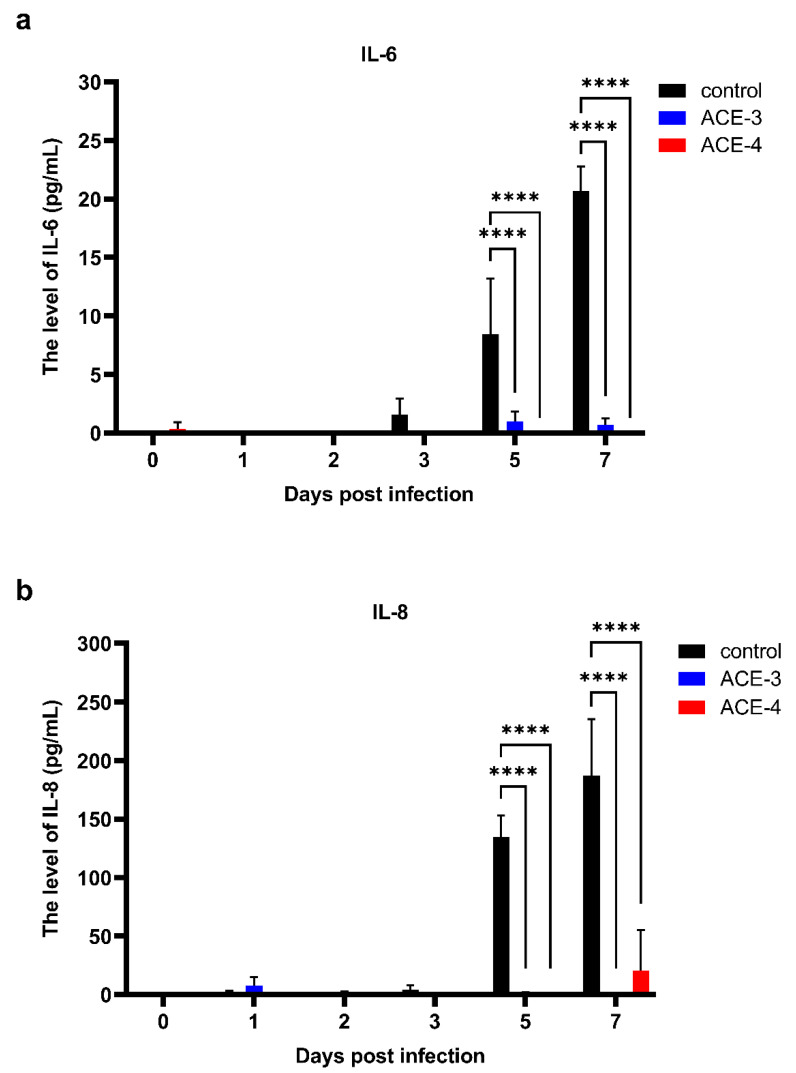
Figure 3
ACE-3 and ACE-4 suppressed the…
Figure 3
ACE-3 and ACE-4 suppressed the expression of the IL-6 and IL-8 after DENV…
Figure 3 ACE-3 and ACE-4 suppressed the expression of the IL-6 and IL-8 after DENV infection. The levels of (a) IL-6 and (b) IL-8, in Meg-01 cells treated with the A. cinnamomea extracts after DENV infection. All the values represent as mean ± SEM of three experiments. p values were calculated using two-way ANOVA, p < 0.0001 **** compared to the control.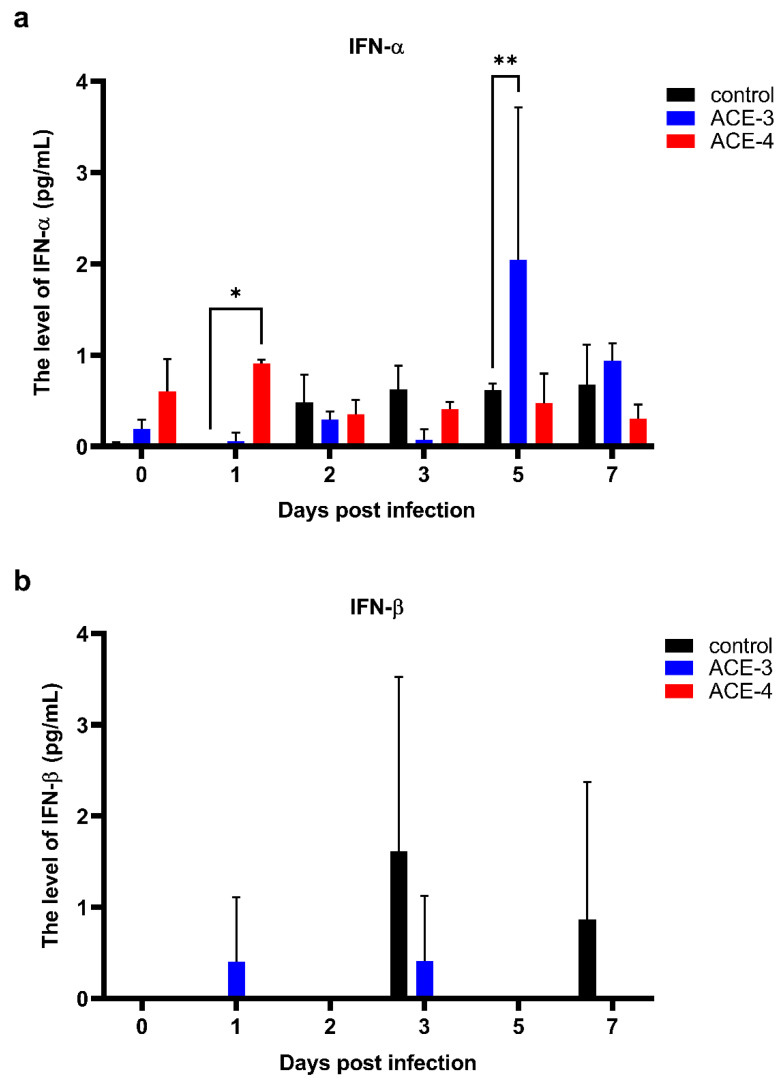
Figure 4
ACE-3 and ACE-4 may inhibit…
Figure 4
ACE-3 and ACE-4 may inhibit DENV replication by enhancing the secretion of IFN-α.…
Figure 4 ACE-3 and ACE-4 may inhibit DENV replication by enhancing the secretion of IFN-α. The levels of antiviral cytokines, (a) IFN-α and (b) IFN-β, in Meg-01 cells treated with A. cinnamomea extracts after DENV infection. All the values represent as mean ± SEM of three experiments. p values were calculated using two-way ANOVA, statistically significant difference * p < 0.05, ** p < 0.01 compared to the control.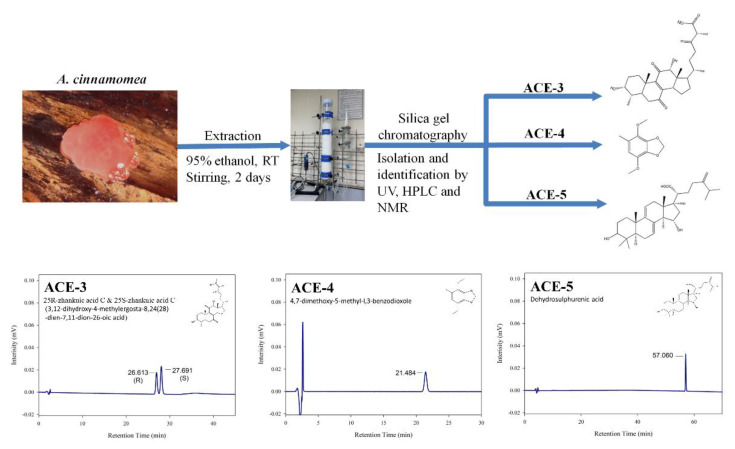
Figure 5
Methods for isolation and identification…
Figure 5
Methods for isolation and identification ofactive compounds from A. cinnamomea .
Figure 5 Methods for isolation and identification ofactive compounds from A. cinnamomea.