
Lyophilized particles and ethanolic extracts of Antrodia cinnamomea mycelia suppress the tumorigenicity of head and neck cancer cells in vivo
Abstract
Head and neck cancer (HNC) is one of the most common forms of cancer in Taiwan. In addition, head and neck cancer cells (HNCs) are highly tumorigenic and resistant to conventional therapy. Therefore, development of new therapeutic regimens that are adjuvant to conventional treatments would benefit future head and neck cancer therapy. In this study, we found that the lyophilized particles and ethanolic extracts of Antrodia cinnamomea mycelia inhibited the tumor growth of HNCs by xenograft assay in vivo. Moreover, administration of lyophilized particles or ethanolic extracts to nude mice did not cause significant side effects. Our study revealed that the Antrodia cinnamomea mycelia extract (ACME) efficiently inhibited the tumorigenicity of HNCs without causing organ failure. Furthermore, it showed that ACME may work as a novel drug candidate for alternative treatments for head and neck cancer.
Figures 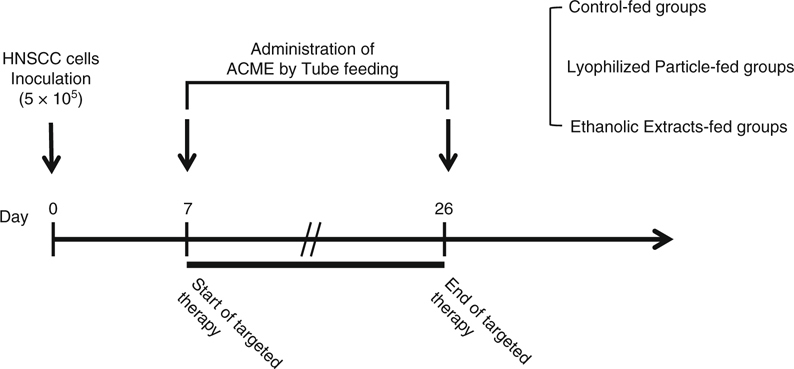
Fig. 1
Overview of the xenograft mice…
Fig. 1
Overview of the xenograft mice model with ACM or ACME feeding procedure. Parental…
Fig. 1 Overview of the xenograft mice model with ACM or ACME feeding procedure. Parental HNSCC cells (5 × 10⁵ cells) were subcutaneously implanted into the back of nude mice to develop tumor to a size about 0.1 cm3. At day 7 after cells implantation, tumor-bearing nude mice were fed with lyophilized particles or ethanolic extracts diet (3 times per week) for 21 day by tube feeding, respectively.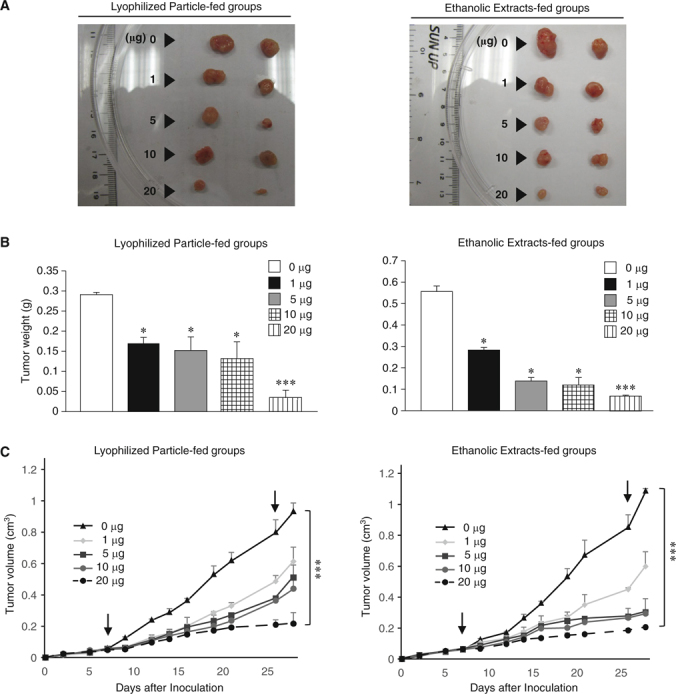
Fig. 2
ACM or ACME feeding reduced…
Fig. 2
ACM or ACME feeding reduced the tumor growth in BALB/c mice injected with…
Fig. 2 ACM or ACME feeding reduced the tumor growth in BALB/c mice injected with SAS cells. Mice were injected with SAS cells followed by feeding with ACM or ACME, and then sacrificed as described in Figure 1. (A) Images of dissected tumors were collected on day 28 from lyophilized particle-fed and ethanolic extracts-fed mice. (the first row: H2O (control), the second row: treated with 1 μg, the third row: treated with 5 μg, the fourth row: treated with 10 μg and the fifth row: treated with 20 μg). (B) The tumors were removed from lyophilized particle-fed and ethanolic extracts-fed mice and weighed. (C) The tumor growth curves of HNSCC cells in nude mice treated with lyophilized particle and ethanolic extracts were recorded.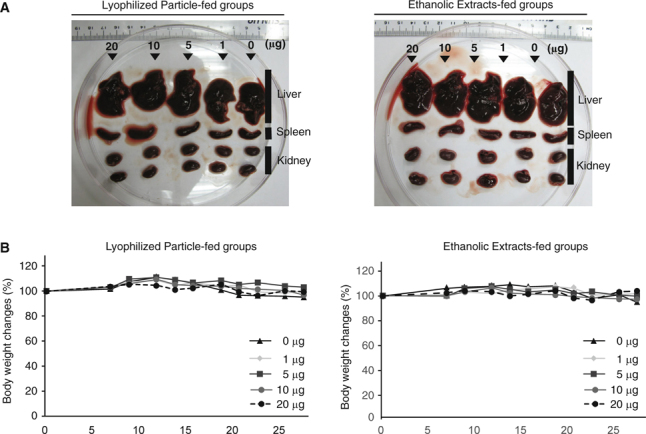
Fig. 3
Gross appearance of organs and…
Fig. 3
Gross appearance of organs and body weight measurement during the ACME feeding model.…
Fig. 3 Gross appearance of organs and body weight measurement during the ACME feeding model. Gross appearance of organs of mice followed by lyophilized particles or ethanolic extracts treatment after 28 day of tumor development. (B) Measurement of body weight of tumor-bearing nude mice (n = 4) during the course of the lyophilized particles feeding or ethanolic extracts feeding.