
Ethanol extracts of Cinnamomum kanehirai Hayata leaves induce apoptosis in human hepatoma cell through caspase-3 cascade
Abstract
Inducing apoptosis to susceptible cells is the major mechanism of most cytotoxic anticancer drugs in current use. Cinnamomum kanehirai Hayata (Lauraceae), a unique and native tree of Taiwan, is the major host for the medicinal fungus Antrodia cinnamomea which exhibits anti-cancer activity. Because of the scarcity of A. cinnamomea, C. kanehirai Hayata instead, is used as fork medicine in liver cancer. Here we observed the C. kanehirai Hayata ethanol extract could inhibit the cellular viability of both HepG2 and HA22T/VGH human hepatoma cell lines in a dose- and time-dependent manner. We found the mode of cell death was apoptosis according to cell morphological changes by Liu's stain, oligonucleosomal DNA fragmentation by gel electrophoresis, externalization of phosphotidyl serine by detecting Annexin V and hypoploid population by cell cycle analysis. Our results showed that the extracts caused cleavage of caspase-3 and increased enzyme activity of caspase-8 and caspase-9. Caspase 3 inhibitor partially reversed the viability inhibition by the extract. Furthermore, the up-regulation of Bax and down-regulation of Bcl-2 were also noted by the extract treatment. In conclusion, C. kanehirai Hayata ethanol extract induced intrinsic pathway of apoptosis through caspase-3 cascade in human hepatoma HA22T/VGH and HepG2 cells, which might shed new light on hepatoma therapy.
Figures 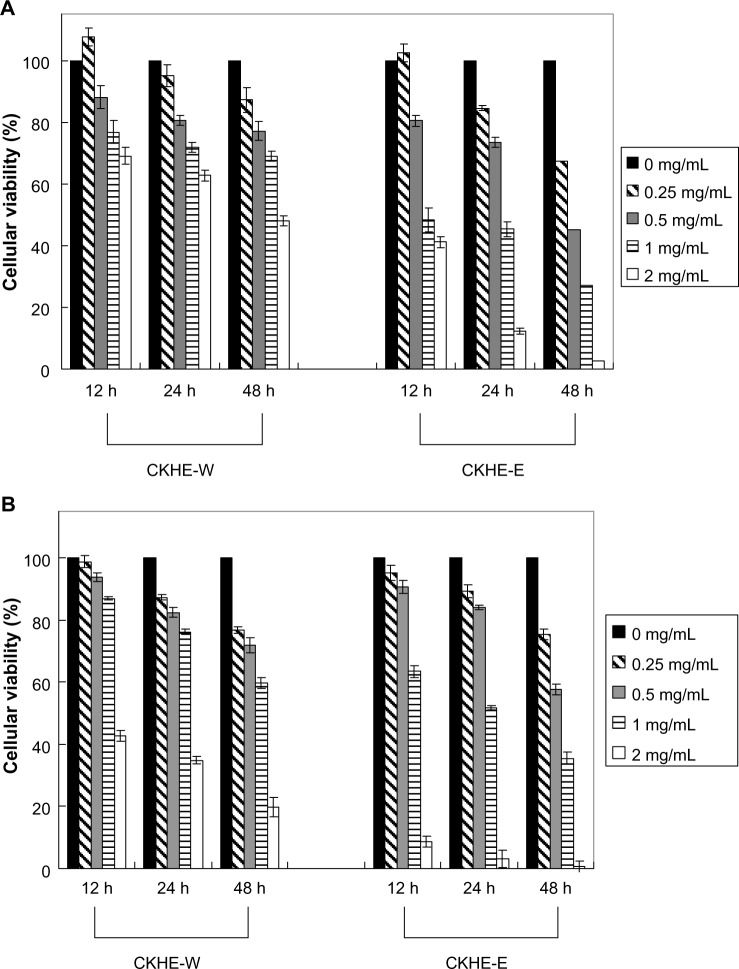
Figure 1
The anti-proliferation activities of different…
Figure 1
The anti-proliferation activities of different fractions from Cinnamomum kanehirai Hayata leaves against human…
Figure 1 The anti-proliferation activities of different fractions from Cinnamomum kanehirai Hayata leaves against human hepatoma cells. HA22T/VGH cells (A) and HepG2 cells (B) were treated with CKHE-W or CKHE-E (0.25–2.00 mg/mL) for 12, 24, and 48 hours, respectively. The cell viability was then determined using MTT assay. Notes: This experiment was repeated three times. The data represents the mean ± SD. Abbreviations: CKHE-E, ethanol Cinnamomum kanehirai Hayata extract; CKHE-W, water Cinnamomum kanehirai Hayata extract; MTT, 3-(4,5-dimethylthiazol-2-yl)-2,5-diphenyltetrazolium bromide; SD, standard deviation; h, hours.
Figure 2
CKHE-E induced cell morphological change.…
Figure 2
CKHE-E induced cell morphological change. Liu’s stain morphology of HA22T/VGH and HepG2 human…
Figure 2 CKHE-E induced cell morphological change. Liu’s stain morphology of HA22T/VGH and HepG2 human hepatoma cells (A and B), and both cells treated with 0.5 mg/mL for 48 hours (C and D, respectively). Notes: DAPI stain, original magnification ×1,000; the triangle markers represent cell shrinkage; white arrow markers represent apoptotic body formation; scale bar, 20 μm. Abbreviations: CKHE-E, ethanol Cinnamomum kanehirai Hayata extract; DAPI, 4′,6-diamidino-2-phenylindole.
Figure 3
CKHE-E induced apoptosis in human…
Figure 3
CKHE-E induced apoptosis in human hepatoma cells. ( A ) HA22T/VGH cells and…
Figure 3 CKHE-E induced apoptosis in human hepatoma cells. (A) HA22T/VGH cells and HepG2 cells were treated with 0.5 or 1.0 mg/mL of CKHE-E for 24 hours, and examined by DNA fragmentation assay. (B) HA22T/VGH cells and HepG2 cells were treated with 0.5 or 1.0 mg/mL of CKHE-E for 24 and 48 hours, respectively. Notes: Cell apoptosis percentages were determined by flow cytometry with Annexin-V/PI staining. The experiments were repeated three times. Abbreviations: CKHE-E, ethanol Cinnamomum kanehirai Hayata extract; PI, propidium iodide; h, hours.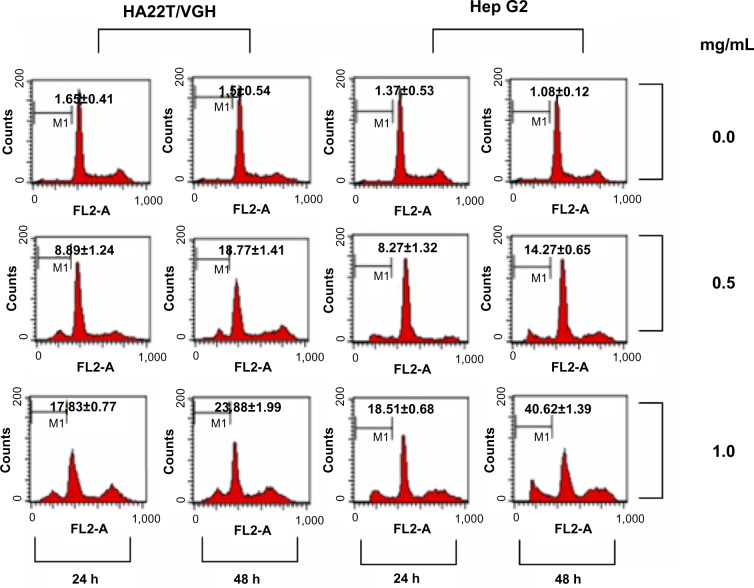
Figure 4
Effect of CKHE-E on cell…
Figure 4
Effect of CKHE-E on cell cycle progression in human hepatoma cells. HA22T/VGH and…
Figure 4 Effect of CKHE-E on cell cycle progression in human hepatoma cells. HA22T/VGH and HepG2 cells were treated with 0.5 and 1.0 mg/mL CKHE-E for 24 and 48 hours, respectively, and analyzed for PI-stained DNA content by flow cytometry. Notes: The indicated percentages are the mean of three independent experiments, each in triplicate. The sub-G1 phase cells increased with time. Abbreviations: CKHE-E, ethanol Cinnamomum kanehirai Hayata extract; PI, propidium iodide; h, hours.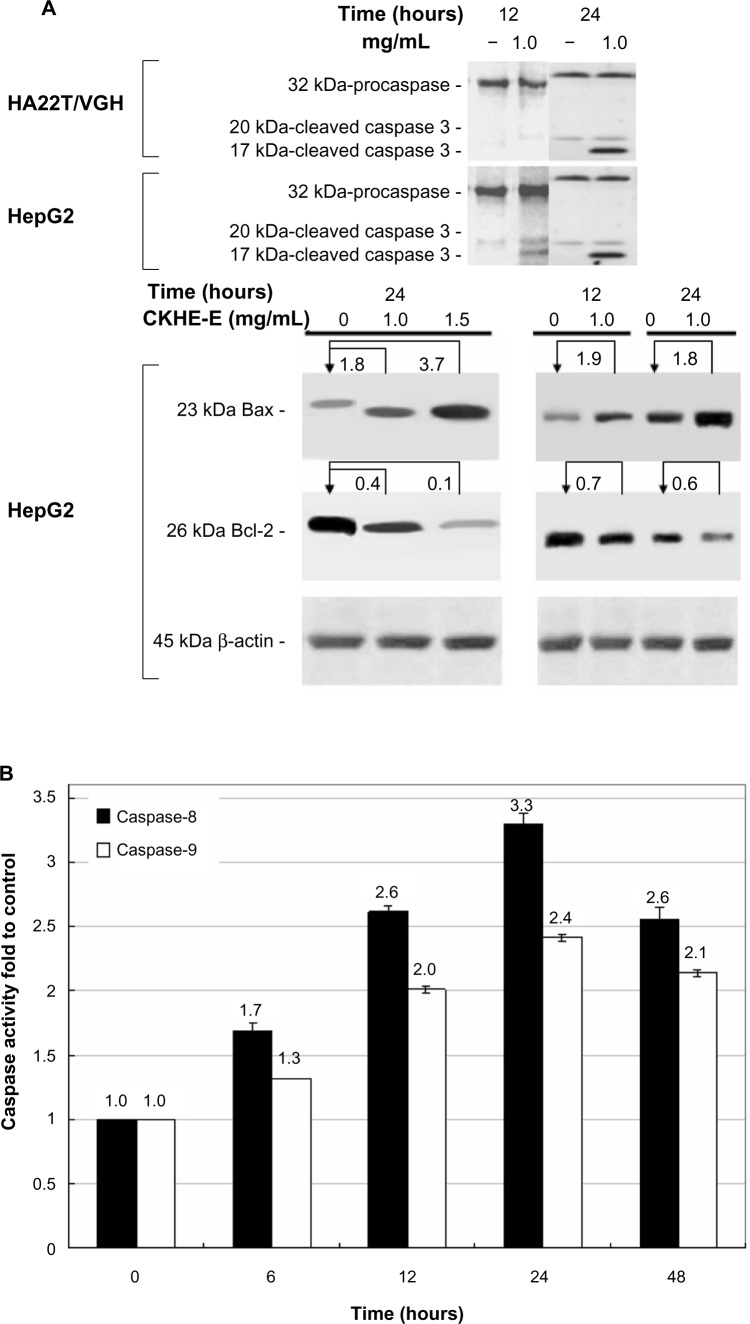
Figure 5
Effect of CKHE-E on human…
Figure 5
Effect of CKHE-E on human hepatoma cells intrinsic pathway of apoptosis. ( A…
Figure 5 Effect of CKHE-E on human hepatoma cells intrinsic pathway of apoptosis. (A) HA22T/VGH and HepG2 cells treated with 1.0 mg/mL CKHE-E for 12 and 24 hours. Cells were then harvested and lysed for the detection of cleaved caspase-3, Bax, Bcl-2, and β-actin protein expression. (B) HepG2 cells treated with 0.25 mg/mL CKHE-E for 6, 12, 24, and 48 hours. Cells were then harvested and lysed for the detection of caspase-8 and -9 activity assay. (C) HA22T/VGH and HepG cells were co-incubated with the cell-permeable caspase-3 inhibitors (50 μM) and CKHE-E (1 and 2 mg/mL) for 48 hours, respectively. The effect on cell growth was examined by MTT assay, and the percentage of cell proliferation was calculated by defining the absorption of cells with DMSO as 100%. Notes: This experiment was repeated three times. Bar represents the SEM. Values were significantly different from the control group. *P<0.05. Abbreviations: CKHE-E, ethanol Cinnamomum kanehirai Hayata extract; DMSO, dimethyl sulfoxide; MTT, 3-(4,5-dimethylthiazol-2-yl)-2,5-diphenyltetrazolium bromide; SEM, standard error of the mean.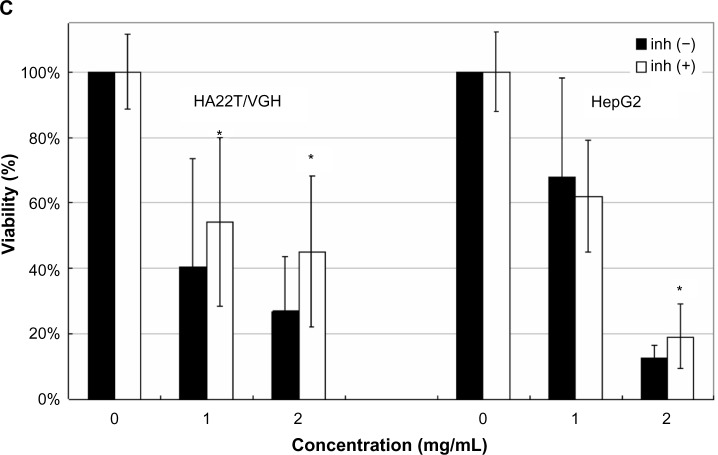
Figure 5
Effect of CKHE-E on human…
Figure 5
Effect of CKHE-E on human hepatoma cells intrinsic pathway of apoptosis. ( A…
Figure 5 Effect of CKHE-E on human hepatoma cells intrinsic pathway of apoptosis. (A) HA22T/VGH and HepG2 cells treated with 1.0 mg/mL CKHE-E for 12 and 24 hours. Cells were then harvested and lysed for the detection of cleaved caspase-3, Bax, Bcl-2, and β-actin protein expression. (B) HepG2 cells treated with 0.25 mg/mL CKHE-E for 6, 12, 24, and 48 hours. Cells were then harvested and lysed for the detection of caspase-8 and -9 activity assay. (C) HA22T/VGH and HepG cells were co-incubated with the cell-permeable caspase-3 inhibitors (50 μM) and CKHE-E (1 and 2 mg/mL) for 48 hours, respectively. The effect on cell growth was examined by MTT assay, and the percentage of cell proliferation was calculated by defining the absorption of cells with DMSO as 100%. Notes: This experiment was repeated three times. Bar represents the SEM. Values were significantly different from the control group. *P<0.05. Abbreviations: CKHE-E, ethanol Cinnamomum kanehirai Hayata extract; DMSO, dimethyl sulfoxide; MTT, 3-(4,5-dimethylthiazol-2-yl)-2,5-diphenyltetrazolium bromide; SEM, standard error of the mean.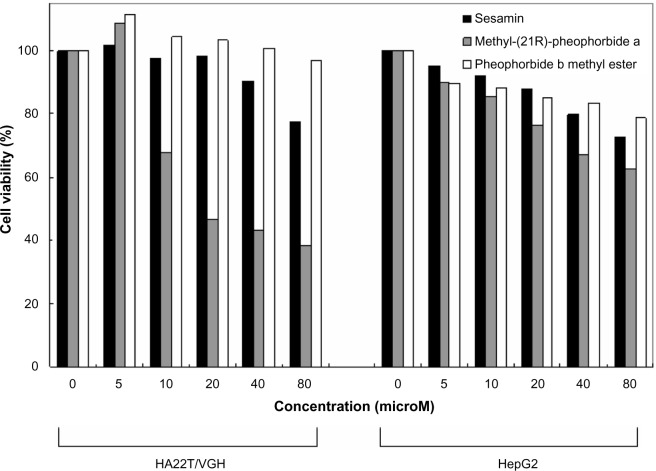
Figure 6
The anti-proliferation activities of sesamin,…
Figure 6
The anti-proliferation activities of sesamin, methyl (21R) pheophorbide a, and pheophorbide b methyl…
Figure 6 The anti-proliferation activities of sesamin, methyl (21R) pheophorbide a, and pheophorbide b methyl ester on HA22T/VGH and HepG2 cells. Both HA22T/VGH and HepG2 cells were treated with various concentrations of sesamin, methyl (21R) pheophorbide a, and pheophorbide b methyl ester at 37°C for 48 hours. The effect on cell growth was examined by MTT assay, and the percentage of cell proliferation was calculated by defining the absorption of control as 100%. Note: This experiment was repeated three times. Abbreviation: MTT, 3-(4,5-dimethylthiazol-2-yl)-2,5-diphenyltetrazolium bromide. All figures (7)