
Antrodia cinnamomea polysaccharide improves liver antioxidant, anti-inflammatory capacity, and cecal flora structure of slow-growing broiler breeds challenged with lipopolysaccharide
Abstract
Lipopolysaccharides (LPS) induces liver inflammatory response by activating the TLR4/NF-κB signaling pathway. Antrodia cinnamomea polysaccharide (ACP) is a medicinal mushroom that can protect from intoxication, liver injury, and inflammation. Nevertheless, the effect of ACP on the liver antioxidant, anti-inflammatory capacity and cecal flora structure of LPS-challenged broilers remains unclear. The aim of this experiment was to investigate the effects of ACP on the anti-oxidative and anti-inflammatory capacities of the liver, and cecal microbiota in slow-growing broilers stimulated by LPS. A total of 750 slow-growing broilers (9-day-old) were assigned to five treatments with 6 replicates of 25 chicks per replicate: a control diet, the chicks were fed a control diet and challenged with LPS. Dietary treatments 3 to 5 were the control diet supplemented with 100, 200, 400 mg/kg ACP challenged with LPS, respectively. The groups of 100 mg/kg ACP supplementation significantly increased liver index, pancreas index, and bursa of Fabricius index (P < 0.05). The GSH-Px content of LPS-challenged broilers was lower than that of the control group (P < 0.001), but the content of MDA increased (P < 0.001). Feeding with 100 mg/kg ACP resulted in increased the activity of T-AOC, GSH-Px, and T-SOD, and decreased MDA content (P < 0.05). The activity of TNF-α, IL-1β, and IL-6 of the LPS group increased, but these indicators were decreased with supplemental 100 mg/kg ACP (P < 0.05). Dietary application of ACP up to 100 mg/kg down-regulated (P < 0.05) the expression of TLR4/NF-κB pathway in the liver induced by LPS. The results of 16S rRNA demonstrated that feeding with 100 mg/kg ACP can change the diversity and composition of the gut microbiota, and restrained the decline of beneficial cecal microbiota (typically Lactobacillus, Faecalibacterium, and Christensenellaceae R-7 group) in the challenged LPS group (P < 0.05). Conclusively, feeding a diet with 100 mg/kg ACP may have beneficial effects on liver damage and the bacterial microbiota diversity and composition in the ceca of LPS-stressed slow-growing broiler breeds, probably because of its combined favorable effects on antioxidants and cytokines contents, and restoration the decline of beneficial cecal microbiota.
Figures 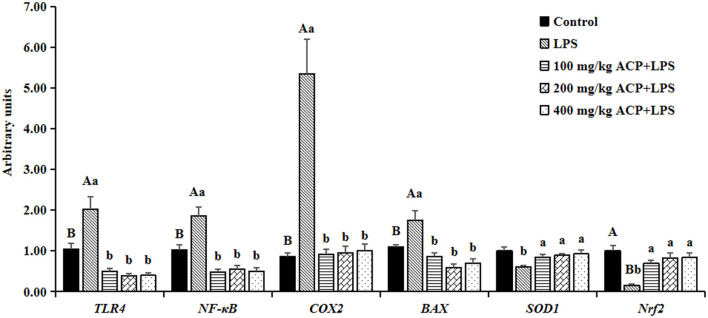
Figure 1
Effects of Antrodia cinnamomea polysaccharide…
Figure 1
Effects of Antrodia cinnamomea polysaccharide on mRNA expression abundance of antioxidant and anti-damage…
Figure 1 Effects of Antrodia cinnamomea polysaccharide on mRNA expression abundance of antioxidant and anti-damage genes in liver of slow-growing broiler breeds challenged with LPSa. Values are means of 6 replicates per treatment with 2 samples each. LPS, Lipopolysaccharide; ACP, Antrodia cinnamomea polysaccharide; TLR4, toll-like receptor (TLR)4; NF-κB, nuclear factor kappa B; COX2, Cyclooxygenase 2; Nrf2, nuclear factor erythroid-2 related factor 2; SOD1, superoxide dismutase-1; BAX, B-cell lymphoma/leukemia-2-associated X protein; Control, basal diet group; LPS, basal diet+LPS stress group. 100 mg/kg ACP+LPS, basal diet+LPS stress+100 mg/kg ACP group. 200 mg/kg ACP+LPS, basal diet+LPS stress+200 mg/kg ACP group. 400 mg/kg ACP+LPS, basal diet+LPS stress+400 mg/kg ACP group. aData are expressed as means±SEM. SEM, standard error. Capital letters indicate statistically significant (P < 0.05) differences between control group and LPS group by Student's t-test; small letters indicate statistically significant (P < 0.05) differences of four groups (LPS, 100 mg/kg ACP+LPS, 200 mg/kg ACP+LPS, 400 mg/kg ACP+LPS). Bars with no common superscript differ significantly (P < 0.05).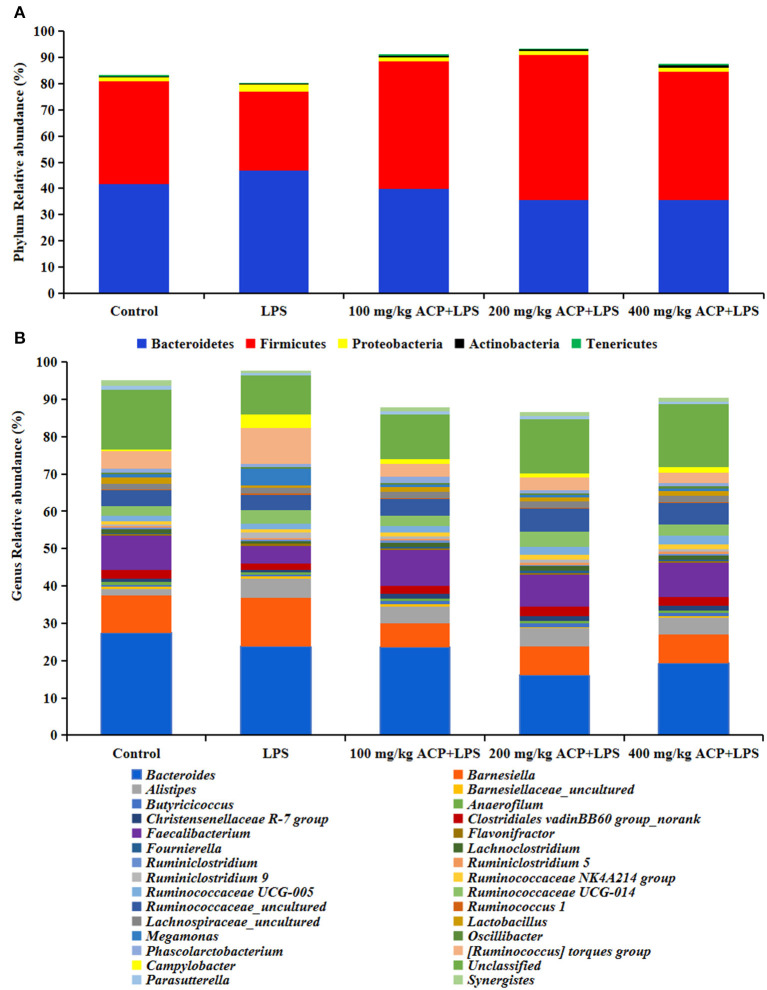
Figure 2
Effects of Antrodia cinnamomea polysaccharide…
Figure 2
Effects of Antrodia cinnamomea polysaccharide on microbiome composition in the cecum of slow-growing…
Figure 2 Effects of Antrodia cinnamomea polysaccharide on microbiome composition in the cecum of slow-growing broilers challenged with LPS. (A) Composition and distribution of the microbiota at the phylum level. (B) Composition and distribution of the microbiota at the genus level. Values are means of 6 replicates per treatment. LPS, Lipopolysaccharide; ACP, Antrodia cinnamomea polysaccharide; Control, basal diet group; LPS, basal diet+LPS stress group; 100 mg/kg ACP+LPS, basal diet+LPS stress+100 mg/kg ACP group. 200 mg/kg ACP+LPS, basal diet+LPS stress+200 mg/kg ACP group. 400 mg/kg ACP+LPS, basal diet+LPS stress+400 mg/kg ACP group.