
Triterpene acid from Antrodia camphorata alleviates inflammation in acute liver injury
Abstract
This study aimed to investigate the role and mechanism of Anctin A, the Antrodia camphorata terpene component, in resisting liver injury. Network pharmacology analysis revealed that MAPK3 was the major action target of Antcin A. Furthermore, experimental research suggested that Antcin A suppressed mouse liver injury, reduced the inflammatory factor levels, and enhanced the anti-oxidative capacity. Meanwhile, it suppressed the expression of MAPK3 and the downstream NF-κB signal, while it did not significantly affect the expression of MAPK1. Based on network pharmacology method, this study discovers that the anti-liver injury effect of Antcin A is mainly related to MAPK3, and that Antcin A can suppress the activation of MAPK3 and its downstream NF-κB to inhibit mouse ALI.
Figures 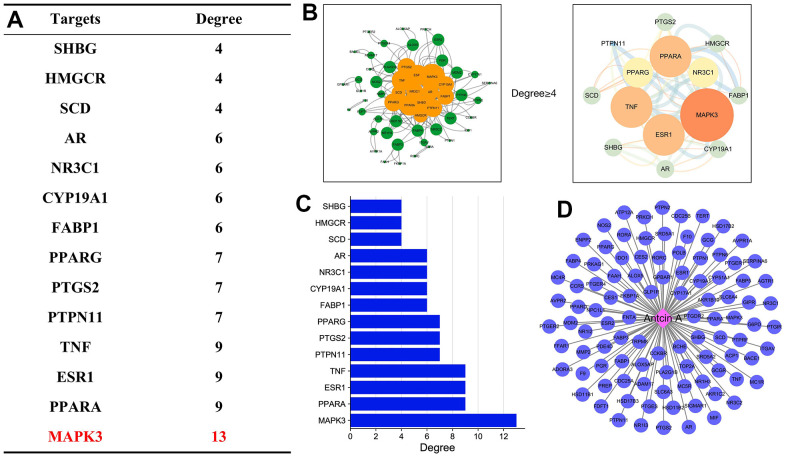
Figure 1
Target analysis of Antcin A…Figure 1
Target analysis of Antcin A and liver injury. ( A ) After target… Figure 1 Target analysis of Antcin A and liver injury. (A) After target screening between Antcin A and liver injury, the core targets were mainly related to MAPK3 and TNF, and were closely associated with anti-inflammation. (B, C) Analysis of target screening and enrichment was mainly related to 6 core targets. (D) There were 73 Antcin A-related targets.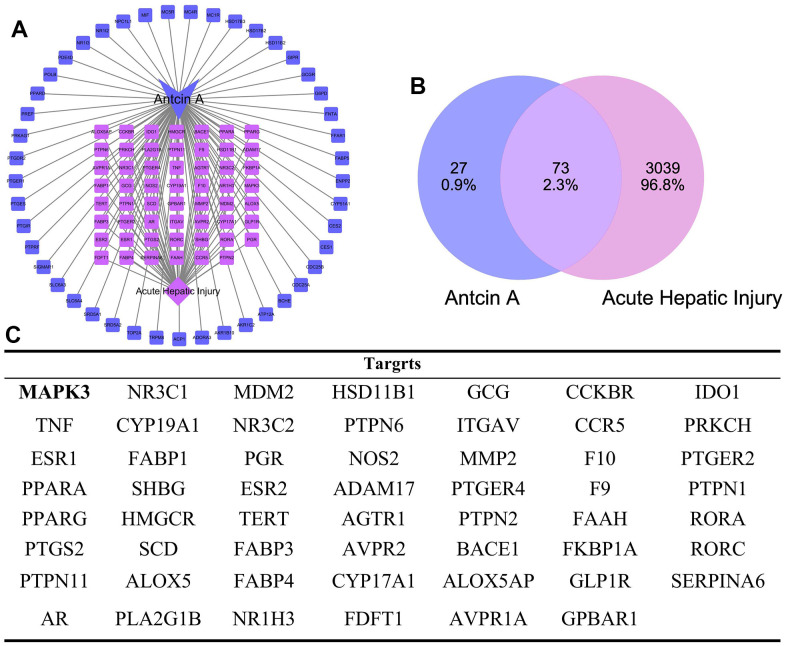
Figure 2
Intersected targets between Antcin A…Figure 2
Intersected targets between Antcin A and liver injury. ( A , B )… Figure 2 Intersected targets between Antcin A and liver injury. (A, B) PPI network construction and topology analysis suggested that there were 100 drug targets, 3039 disease-related genes, and the intersection between these gene sets resulted in 73 intersected genes, including 14 core targets (like MAPK3). (C) Display of all targets.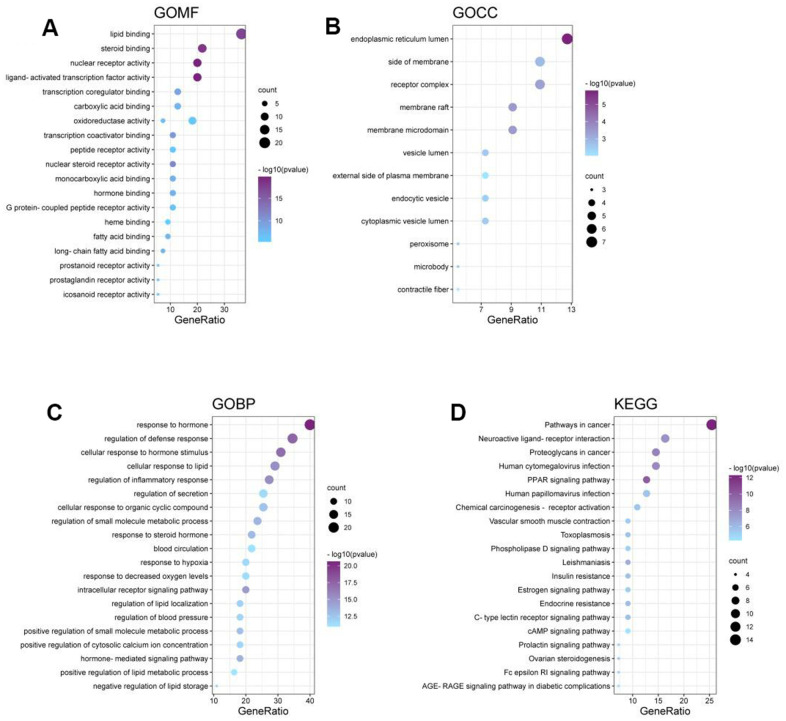
Figure 3
Results of Antcin A in…Figure 3
Results of Antcin A in relation to disease. ( A – D )… Figure 3 Results of Antcin A in relation to disease. (A–D) The role of Antcin A in treating disease mainly involved 842 BPs, 12 CCs and 108 MFs.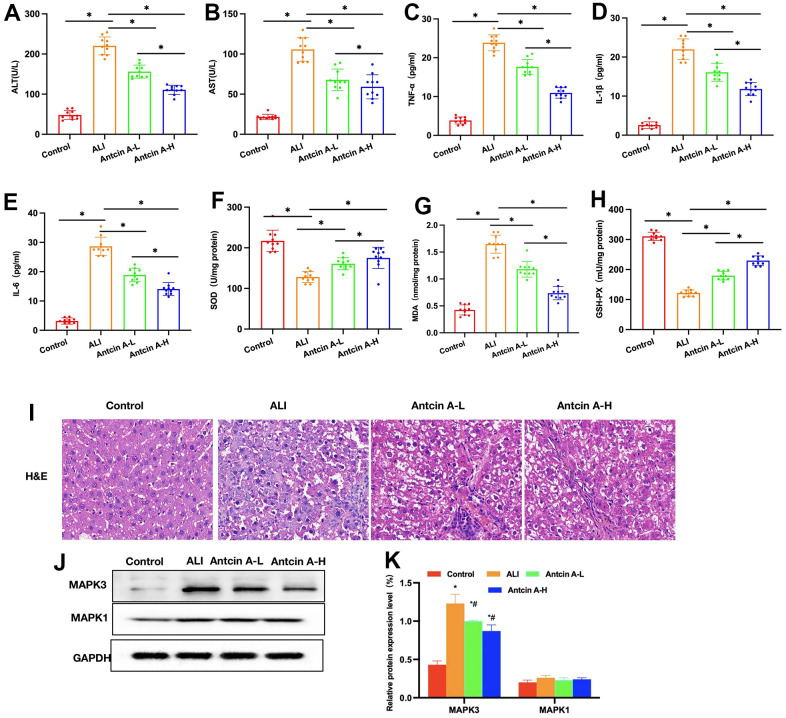
Figure 4
Antcin A suppresses liver injury…Figure 4
Antcin A suppresses liver injury in mice. ( A , B ) ALT… Figure 4 Antcin A suppresses liver injury in mice. (A, B) ALT and AST levels (n=10): The ALT and AST levels in ALI mice increased, and the differences were significant compared with Control group. Antcin A treatment suppressed liver injury, and decreased ALT and AST levels, with significant differences between groups (*P<0.05). (C–E) ELISA (n=10). The levels of inflammatory factors IL-6, IL-1β and TNF-α in ALI mice increased, while Antcin A treatment suppressed the expression of inflammatory factors, with significant differences between groups (*P<0.05). (F–H) Levels of SOD, MDS and GSH-Px (n=10). Antcin A enhanced the levels of SOD and GSH-Px, but decreased that of MDA, and there were significant difference between groups (*P<0.05). (I) H&E (n=5). Liver tissues developed inflammation, edema and necrosis in ALI group, with obvious cell injury, while no obvious injury was observed in Control group, and Antcin A reduced inflammatory response and cell injury in tissues. (J, K) Relative protein expression levels (n=5). Antcin A did not significantly affect MAPK1 expression, but it decreased the expression levels of MAPK3. *P<0.05 compared with Control group, #P<0.05 compared with ALI group.