
Identification and Isolation of an Intermediate Metabolite with Dual Antioxidant and Anti-Proliferative Activity Present in the Fungus Antrodia cinnamomea Cultured on an Alternative Medium with Cinnamomum kanehirai Leaf Extract
Abstract
The fungus Antrodia cinnamomea has been used as a folk medicine for various diseases, especially cancer. When A. cinnamomea is cultured on the original host, an endangered woody plant Cinnamomum kanehirai Hayata, the fungus produces more active ingredients, but its growth is slow. Here, C. kanehirai leaf ethanol extract (KLEE) was used as a substitute for C. kanehirai wood to culture A. cinnamomea on solid medium to shorten the culture period and produce active metabolites en masse. The antioxidant activities of methanol extracts from A. cinnamomea cultured on KLEE (MEAC-KLEE) were evaluated by 2,2-diphenyl-1-picrylhydrazyl (DPPH) radical-scavenging effect, reducing power, and ferrous ion-chelating effect, and the effective concentration (EC50) values were 0.27, 0.74, and 0.37 mg mL-1, respectively. MEAC-KLEE exhibited specific anti-proliferative activity against a non-small-cell lung cancer cell line (A549) by Annexin V assay. A secondary metabolite (2,4-dimethoxy-6-methylbenzene-1,3-diol, DMMB) present in the extract (MEAC-KLEE) was purified by high-performance liquid chromatography (HPLC) and identified by nuclear magnetic resonance (NMR) spectra. DMMB exhibited moderate antioxidant activity against DPPH radicals and reducing power, with EC50 values of 12.97 and 25.59 μg mL-1, respectively, and also induced apoptosis in A549 cells. Our results provide valuable insight into the development of DMMB for nutraceutical biotechnology.
Figures 
Figure A1
Morphology of colonies of A.…
Figure A1
Morphology of colonies of A. camphobrata ACT4. A. camphobrata ACT4 was cultured on…
Figure A1 Morphology of colonies of A. camphobrata ACT4. A. camphobrata ACT4 was cultured on (a) cPDA medium for 29 days, (b) JTA medium for 29 days, (c) JTA-squalene medium for 32 days, (d) JTA-KLEE medium for 32 days, (e) JKLWE medium for 32 days, (f) J KFW medium for 32 days, or (g) JTA-chitosan medium for 39 days. The morphology of colonies was showed on the left and the view under a stereomicroscope (20×) was showed on the right.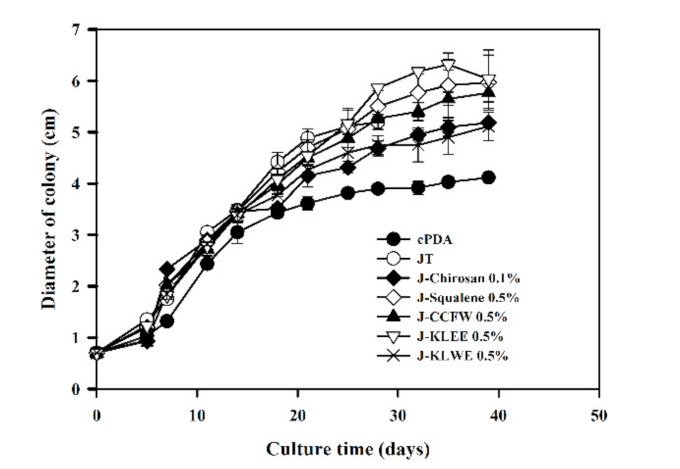
Figure 1
Growth curves for A. camphorata…
Figure 1
Growth curves for A. camphorata cultured on various media. Each value is expressed…
Figure 1 Growth curves for A. camphorata cultured on various media. Each value is expressed as the mean ± SD (n = 3).
Figure 2
Antioxidant activity assays of MEs…
Figure 2
Antioxidant activity assays of MEs of A. cinnamomea mycelia, inoculated medium (in-medium), and…
Figure 2 Antioxidant activity assays of MEs of A. cinnamomea mycelia, inoculated medium (in-medium), and fresh medium. (a) DPPH free radical-scavenging effects. (b) Reducing power of ferrous ions. (c) Ferrous ion-chelating effects. The MEs of A. cinnamomea mycelia from cultured on JTA. Each value is expressed as the mean ± SD (n = 3).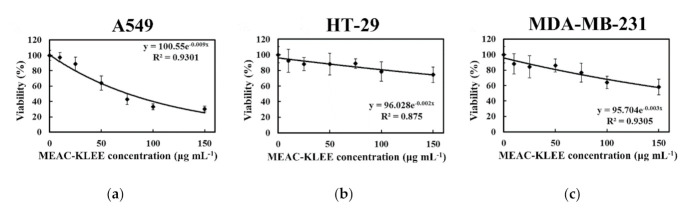
Figure 3
Effects of MEAC-KLEE on cancer…
Figure 3
Effects of MEAC-KLEE on cancer cells. After treated with MEAC-KLEE, the viabilities of…
Figure 3 Effects of MEAC-KLEE on cancer cells. After treated with MEAC-KLEE, the viabilities of (a) A549, (b) HT-29, and (c) MDA-MB-231 cells were analyzed according to the formazan-based cell proliferation reagent WST-1 assay. Each value is expressed as the mean ± SD (n = 3).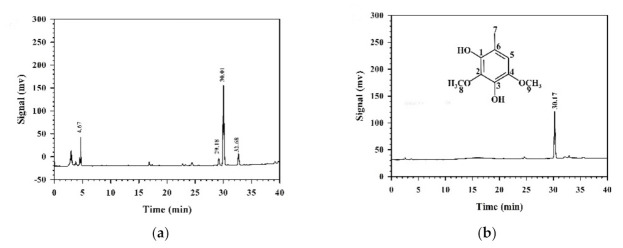
Figure 4
HPLC fingerprints of MEAC-KLEE (…
Figure 4
HPLC fingerprints of MEAC-KLEE ( a ) and its purified fraction ( b…
Figure 4 HPLC fingerprints of MEAC-KLEE (a) and its purified fraction (b) on an SPE C18 column. The chemical structure of the main peak was identified as DMMB (MW 170) based on 1H-NMR, 13C-NMR, and mass spectra.
Figure 5
Antioxidant activity assays of DMMB.…
Figure 5
Antioxidant activity assays of DMMB. ( a ) DPPH free radical-scavenging effects. (…
Figure 5 Antioxidant activity assays of DMMB. (a) DPPH free radical-scavenging effects. (b) Reducing power. Each value is expressed as the mean ± SD (n = 3).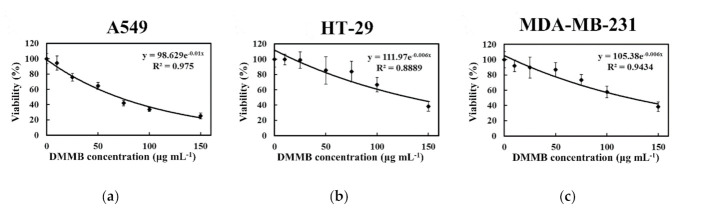
Figure 6
Effects of DMMB on cancer…
Figure 6
Effects of DMMB on cancer cells. After treated with DMMB, the viabilities of…
Figure 6 Effects of DMMB on cancer cells. After treated with DMMB, the viabilities of (a) A549, (b) HT-29, and (c) MDA-MB-231 cells were analyzed according to the formazan-based cell proliferation reagent WST-1 assay. Each value is expressed as the mean ± SD (n = 3). All figures (7)